

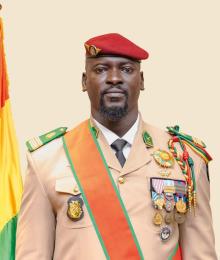
Mamadi Doumbouya is a Guinean military officer and statesman, born on December 5, 1984, in Kankan, who has led Guinea since the coup d’état of September 5, 2021, which overthrew President Alpha Condé. A former legionnaire of the French Army (2002–2009), he received training at several prestigious military institutions, including the War College in France. In 2018, he assumed command of the Guinean Special Forces Group before leading the putsch.
Initially serving as president of the transition and having pledged not to run in elections, he was ultimately elected President of the Republic in December 2025 with 86.72% of the vote, following the adoption of a new Constitution that removed the ban on members of the military standing for office.
Holder of a master’s degree in defense studies from Paris Panthéon-Assas University, married to a French gendarme and the father of four children, Doumbouya embodies a generation of highly trained African officers who favor a strategy of international non-alignment while maintaining an authoritarian style of governance marked by repression of the opposition and restrictions on public freedoms.
Introduction
Mamadi Doumbouya represents a central figure in contemporary Guinean politics today. Born on December 5, 1984, in Kankan, this career military officer made history in his country by orchestrating the coup d'état of September 5, 2021, which overthrew President Alpha Condé. Having become transitional president and then elected president in December 2025, his trajectory illustrates the complex political transformations that Guinea and, more broadly, the West African region are experiencing.
Origins and Childhood in Kankan
Mamadi Doumbouya was born in the Kankan region, Guinea's second-largest city located in the eastern part of the country. More precisely, he was born in Bananköröda, a neighborhood of this historic city. Coming from the Malinké ethnic group, he is the son of Karifala Doumbouya and Hadja Mandioula Sylla. This Malinké origin would later create connections with President Alpha Condé, himself a member of this ethnic community.
Young Mamadi completed his primary education at the Dramé Oumar school in Kankan, an institution that laid the first foundations of his education. This period of initial training in Guinea deeply marked him and forged his attachment to his native country, an attachment that would later influence his decision to return to serve in the Guinean army after his experience abroad.
International Military Training
Experience in the French Foreign Legion
Mamadi Doumbouya's trajectory took a decisive turn when he joined the French Foreign Legion in 2002. This elite military institution, renowned for its rigor and operational excellence, became his professional training ground. For nearly seven years, until 2009, he served as a legionnaire and reached the rank of corporal.
This experience within the Foreign Legion proved formative in several respects. Doumbouya participated in numerous external military operations that forged his field experience. He was deployed to Afghanistan, a complex theater of operations where he acquired expertise in asymmetric warfare. He also participated in operations in Côte d'Ivoire during the post-electoral crisis, as well as in the Central African Republic. His passage through French forces stationed in Djibouti completed this diversified operational experience.
Complementary Training and Academic Degrees
Beyond his operational experience, Mamadi Doumbouya pursued high-level military academic training. He followed training courses in Senegal, notably at the Infantry Application School in Thiès between 2012 and 2013, where he prepared to become a unit commander. He also benefited from training in Gabon, at the Staff School in Libreville, and in Israel, at the International Security Academy.
The culmination of his academic training came in 2017-2018, when he joined the prestigious French War College as part of its 25th class. This institution trains the elite of French and foreign officers in military strategy and high-level strategic thinking. Doumbouya obtained a French advanced military studies certificate there, thus consolidating his theoretical skills.
Alongside his military training, he pursued civilian studies and earned a master's degree in defense from Paris-Panthéon-Assas University, an institution renowned for its programs in law and political science. He also obtained a Saumur diploma, training intended for African officers within the framework of Franco-African military cooperation.
A Notable Speech in 2017
During a symposium organized in November 2017 in Paris by the Specialized Staff for Overseas and Foreign Affairs, Mamadi Doumbouya, representing African trainees, delivered a speech that attracted attention. He discussed the challenges faced by African officers, notably the distrust of their political leaders. He notably stated that he had requested ammunition to train his troops in shooting without ever receiving it, his leaders fearing he would use it to foment a coup d'état—a declaration that would prove prescient a few years later.
In this intervention, Doumbouya also criticized the sometimes condescending attitude of certain Western officers toward their African counterparts, emphasizing that all graduated from the same military training schools. This speech already revealed an assertive personality and acute awareness of power dynamics between Africa and the West.
Return to Guinea and Military Ascension
The Early Years (2011-2018)
Mamadi Doumbouya returned to Guinea in 2011, marking the beginning of his career within the Guinean army. He was immediately assigned to the Infantry Training Center at Camp Kwamé Nkrumah, located at kilometer 36, first as an instructor then as director of studies. During this period, he trained nearly 4,000 enlisted soldiers and non-commissioned officers, contributing significantly to strengthening the Guinean army's capabilities.
After following several unit commander training courses in Senegal, he was transferred to the Infantry Training Center in Kindia. This period allowed him to gradually climb the hierarchical ranks and gain recognition from his superiors for his professional skills and international experience.
Command of the Special Forces Group (2018-2021)
The year 2018 marked a major turning point in Mamadi Doumbouya's career. On the recommendation of Chadian President Idriss Déby Itno, who advised Alpha Condé to create an elite unit to counter potential terrorist threats, the Guinean president decided to establish the Special Forces Group (GFS). Doumbouya, then promoted to the rank of commander, was chosen to lead this new unit based in Kalako, in the prefecture of Forécariah.
The choice of Doumbouya for this strategic position was explained by his exceptional background and international experience. His time in the French Foreign Legion, his multiple training courses, and his operational deployments made him an ideal candidate to shape this elite unit. He rigorously recruited and trained several hundred young military personnel, developing a unit specialized in counterterrorism and special operations.
In February 2019, Doumbouya represented Guinea at the Flintlock military training exercise in Ouagadougou, Burkina Faso. This exercise, organized by the U.S. Army, brought together the African military elite and special forces commanders from the region. It was at this event that he met and befriended Malian Colonel Assimi Goïta, who would also lead a coup d'état in Mali in 2020.
The rise of the Special Forces Group under Doumbouya's command became visible during the national holiday of September 28, 2018, celebrating 60 years of Guinea's independence. The Guinean population discovered with surprise this new elite unit parading, headed by Lieutenant Colonel Doumbouya. This show of force marked minds and reinforced the prestige of this unit within the Guinean security apparatus.
Doumbouya rapidly climbed the hierarchical ranks: he became lieutenant colonel in 2019, then colonel in 2020. This meteoric rise testified to the confidence Alpha Condé placed in him, but it also raised concerns within the government, particularly from Defense Minister Mohamed Diané.
Growing Tensions with the Government
Throughout 2021, relations between Mamadi Doumbouya and the Guinean government became tense. The Special Forces commander attempted to make his unit less dependent on the Ministry of National Defense, seeking to gain operational and budgetary autonomy. This desire for independence awakened the mistrust of Alpha Condé's regime.
Tensions intensified to the point that rumors circulated in May 2021 concerning a possible arrest of Doumbouya. The regional context, marked by his friend Assimi Goïta's coup d'état in Mali, increased the fears of the Guinean government. The progressive transformation of the Special Forces Group, initially created to fight terrorism and maritime piracy, into an instrument for suppressing political demonstrations also created dissension.
Indeed, during protests against Alpha Condé's third term in 2020, the hooded men of the Special Forces were deployed in Conakry neighborhoods to suppress demonstrations, diverting the elite unit from its original mission. This political use of the elite unit probably contributed to deteriorating relations between Doumbouya and President Condé.
The Coup d'État of September 5, 2021
Seizure of Power and Initial Announcements
On Sunday, September 5, 2021, Mamadi Doumbouya crossed the Rubicon. At the head of the Special Forces Group, he stormed the presidential palace and arrested President Alpha Condé, who had been in power for nearly eleven years. In a message broadcast on national television, Colonel Doumbouya announced the president's arrest, the dismissal of the government, the suspension of the Constitution, the establishment of a curfew, and the closure of land and air borders.
Justifying his action, Doumbouya invoked "the country's socio-political and economic situation, the dysfunction of republican institutions, the instrumentalization of justice, and the trampling of citizens' rights." He proclaimed the establishment of the National Committee for Reconciliation and Development (CNRD) and invited soldiers to remain in their barracks to avoid any overflow.
In a statement that became famous, he affirmed: "We no longer need to rape Guinea: we just need to make love to it, quite simply." This metaphor, though controversial, illustrated his desire to present the coup d'état as an act of rescue rather than political violence.
During his speech, Doumbouya quoted former Ghanaian President Jerry Rawlings, himself having come to power through a coup d'état: "If the people are crushed by their elites, it falls to the army to give the people their freedom." This reference inscribed his action in a tradition of coups d'état justified by defending the people against corrupt or authoritarian leaders.
Initial Reception and Reactions
The coup d'état was initially welcomed jubilantly by part of the Guinean population, tired by months of harshly suppressed demonstrations against Alpha Condé's third term. For many Guineans, Doumbouya appeared as a savior coming to end a regime that had become authoritarian and deaf to democratic aspirations.
On the international level, reactions were more mixed. The Economic Community of West African States (ECOWAS) condemned the coup d'état and suspended Guinea from its bodies. The African Union did the same. However, Doumbouya minimized the impact of potential economic sanctions, declaring through a spokesperson that "as soldiers, their work is in Guinea and there is nothing to freeze in their accounts."
Transitional President (2021-2025)
Installation in Power
Twelve days after the coup d'état, on September 17, 2021, the junta designated Mamadi Doumbouya president of the Republic. On September 27, the transition charter was published, officially making him transitional president. This charter also provided for the designation of a National Transition Council, serving as Parliament, which would draft the next Constitution.
Paradoxically, the charter declared Doumbouya and other junta members ineligible for the next elections—a provision that would later be circumvented. On October 1, 2021, Doumbouya took the oath at the Mohammed V Palace before the Supreme Court, announcing his intention to "refound the State" by organizing "free, credible and transparent" elections while respecting "all national and international commitments to which the country has subscribed."
Government Appointments and Regional Diplomacy
As early as October 6, 2021, Doumbouya appointed Mohamed Béavogui as Prime Minister, signaling his desire to form a civilian government. On October 11, he received a visit from Julius Maada Bio, President of Sierra Leone, who became the first head of state to visit Guinea since the coup d'état. This visit allowed the reopening of borders with neighboring countries and marked an initial regional recognition of the new government.
On December 10, 2021, Doumbouya established the Presidential Priorities Monitoring Office (BSPP), a body responsible for overseeing the execution of the transitional president's priority programs. This initiative testified to his desire to leave his mark on governance and closely control the implementation of his policies.
On the diplomatic front, Doumbouya made several strategic trips. On September 21, 2021, he traveled to Bamako for a working visit, received by his friend Colonel Assimi Goïta, reinforcing ties between the two military juntas in the region. On October 28, 2022, he visited Sierra Leonean President Julius Maada Bio. In June 2023, he participated in the inauguration of Turkish President Recep Tayyip Erdogan in Ankara, and in September 2023, he took part in the 78th session of the United Nations General Assembly in New York.
It was at the UN podium that Doumbouya delivered a notable speech, justifying military coups d'état in Africa and denouncing a democratic model that had allegedly "been imposed" on the continent. He emphasized his non-alignment, declaring himself "neither anti-American," "neither anti-Russian," "neither anti-French," but "simply pro-African." This "neither-nor" strategy allowed him to maintain good relations with all international partners, unlike the Sahelian juntas that broke with France.
Economic and Mining Policies
In April 2022, Doumbouya made a major decision by ordering mining companies majority-owned by foreign capital to launch construction of factories to refine bauxite in the country. This resource nationalism policy aimed to ensure that Guinea benefited more directly from its immense mineral wealth.
Guinea holds the world's largest bauxite reserves and possesses one of the largest unexploited iron ore deposits at Simandou. Doumbouya pointed to progress made on this project as proof of his leadership. The official launch of exploitation of the gigantic Simandou mining complex in December 2025, after years of delays, symbolized the improvement of the country's economic prospects under his reign.
His administration also proceeded with a takeover of the mining sector, notably revoking the license of Guinea Alumina Corporation, a subsidiary of Emirates Global Aluminium, following a dispute concerning the development of a refinery, and transferring its assets to a state-owned company.
Government Changes
On August 20, 2022, Doumbouya appointed Bernard Goumou as Prime Minister to replace Mohamed Béavogui, marking the first major reshuffle of his government. Then, on February 19, 2024, he surprisingly announced the complete dissolution of the transitional government led by Bernard Goumou, without giving immediate details. The CNRD ordered the freezing of bank accounts, withdrawal of bodyguards, recovery of official vehicles, and seizure of passports of former government members.
On February 27, 2024, Doumbouya appointed Bah Oury as Prime Minister, replacing Bernard Goumou. This frequent rotation of Prime Ministers testified to the transitional president's total grip on the government apparatus.
Perpetuation in Power and Repression
Extension of the Transition
In early May 2022, the junta announced a transition of three years and three months. Under pressure from ECOWAS and the international community, this deadline was ultimately shortened to three years in October 2022. Doumbouya then committed to further reducing the transition duration, announcing two years starting from January 2023.
In February 2023, at the launch of drafting the new Constitution, Doumbouya publicly reaffirmed that he would leave power at the end of the transition in late 2024, declaring: "We will certainly organize the transition but we will not be part of the post-transition. For us, this is clear and it must be." He insisted on the importance that the Constitution not be "tailor-made for a political party or political person" because he himself would "not be part of the measure."
These repeated declarations of intention to leave power would ultimately prove to be smoke and mirrors, with Doumbouya progressively maneuvering to maintain himself at the head of state.
Repression and Restriction of Freedoms
Under Doumbouya's presidency, the Guinean political climate progressively deteriorated. The junta banned all demonstrations since 2022. Several political parties and media outlets were suspended. Demonstrations were systematically suppressed, and many opposition leaders and civil society members were arrested, convicted, or forced into exile.
News of forced disappearances and kidnappings multiplied. In July 2024, after the disappearance of political activists Foniké Menguè and Billo Bah, associated with the National Front for the Defense of the Constitution (FNDC), their families filed a complaint in Paris against Mamadi Doumbouya.
In June 2025, the Guinea Bar Association boycotted hearings for two weeks and its members left the national institutions in which they sat, in reaction to the kidnapping and torture of Mohamed Traoré, a former bar president and critic of Doumbouya.
Threats against anti-government demonstrators hardened, with the junta brandishing the threat of life imprisonment. UN High Commissioner for Human Rights Volker Türk denounced in December 2025 an election campaign "severely restricted, marked by intimidation of opposition actors, apparently politically motivated forced disappearances and constraints on media freedom."
Kidnappings of Dissenting Voices
Since the military coup d'état on September 5, 2021, that brought Mamadi Doumbouya to power in Guinea, the country has experienced a disturbing multiplication of forced disappearances targeting opponents and critics of the regime. The junta led by the National Committee for Reconciliation and Development (CNRD) is accused of orchestrating systematic repression against dissenting voices. Documented cases include the July 2024 kidnapping of Oumar Sylla (Foniké Menguè) and Mamadou Billo Bah, leaders of the FNDC citizen movement demanding the return of civilians to power. Journalist Habib Marouane Camara disappeared in December 2024 after being kidnapped by uniformed men in Conakry.
In 2025, repression intensified with the disappearance of griot Djeliman Kouyaté in June, hours after demanding the release of opposition leaders. In September, the father of exiled journalist Mamoudou Babila Keïta, aged 75, was kidnapped in N'Zérékoré, a tactic aimed at pressuring the son critical of the regime.
In November 2025, two children, a nephew and a brother of exiled artist Elie Kamano were kidnapped, prompting the latter to appeal to the UN Working Group on Forced Disappearances.
Despite these serious accusations and international appeals, Guinean authorities deny any involvement, while demonstrations remain banned since 2022 and many opponents are forced into exile.
Military Consolidation and Honors
On January 24, 2024, Doumbouya was elevated to the rank of corps general of the Guinean armed forces and left the head of the Special Forces Group after six years of command, replaced by Colonel Mouctar Kaba. In November 2024, he awarded himself the rank of five-star general, making him the highest-ranking officer in the Guinean army.
Alongside these military promotions, Doumbouya accumulated honorary distinctions. In 2021, he received the Grand Cross of the National Order of Merit of the Republic of Guinea. In 2022, he obtained the Grand Cross of the National Order of the Republic of Mali. In 2023, Gamal Abdel Nasser University of Conakry awarded him an honorary doctorate. In 2024, he was decorated with the Grand Cross of the National Order of the Colatier, Guinea's highest civilian distinction, as well as the War Cross medal.
Toward Elected Presidency
Constitutional Referendum and Lifting of Ineligibility
On December 31, 2023, Doumbouya announced the organization of a constitutional referendum "during the new year." This referendum was finally held on September 21, 2025, exactly four years to the day after the coup d'état. The proposed text received 89.38% of votes according to final results proclaimed by the Supreme Court on September 26.
This new Constitution conveniently lifted the ban on military personnel running for elections and extended the presidential term from five to seven years. On September 26, 2025, Doumbouya promulgated the new Constitution by decree, formally opening the way for his presidential candidacy.
Presidential Election of December 2025
On November 3, 2025, the deadline for submitting candidacies, Mamadi Doumbouya presented himself to the Supreme Court around 4 p.m. to officially file his candidacy for the December 28 presidential election. He presented himself as an independent candidate, supported by the Generation for Modernity and Development (GMD) movement, which bears his initials.
The election took place without major opponents, with Guinea's main opposition figures, Alpha Condé and Cellou Dalein Diallo, living in exile. On December 31, 2025, provisional results were announced: Mamadi Doumbouya won the presidential election with an overwhelming score of 86.72% of votes and a turnout of 80.95% of registered voters. The second-place candidate, Yero Baldé, a former Education Minister under Condé, obtained only 6.51% of votes. This unsurprising victory consecrated his power and conferred electoral legitimacy upon him, although accusations of systematic fraud and intimidation marred the ballot.
Opposition candidate Faya Lansana Millimono denounced "systematic fraudulent practices" and claimed that observers were prevented from monitoring both voting and ballot counting. The government did not comment on these allegations.
Private Life and Personality
Mamadi Doumbouya is married to Lauriane Darboux Doumbouya, a French woman who is an active member of the French National Gendarmerie. The couple has four or five children according to sources. This union with a French woman illustrates the close ties that Doumbouya maintains with France, the former colonial power.
Physically, Doumbouya is described as a colossus with the physique of a high-level athlete. His imposing appearance and elite military background contribute to his strongman image. During his term as transitional president, he generally appeared in camouflage fatigues and a red beret, symbol of his special forces membership. It was only approaching the 2025 presidential election that he progressively adopted civilian attire during his rare public appearances.
His personality is characterized by rare and controlled communication. Shut away in the Mohammed V presidential palace in Conakry, facing the Atlantic Ocean, Doumbouya delegated speaking to his Prime Minister and spokesperson. During the 2025 presidential campaign, he made only a brief one-hour appearance at a rally on the last day of campaigning, otherwise contenting himself with a campaign video promising "peace and stability" to Guineans.
Conclusion
The trajectory of Mamadi Doumbouya, from French legionnaire to elected president of Guinea, illustrates the complex paths of contemporary African military leaders. Trained in the best French and international military schools, he embodies a generation of highly qualified officers who question the democratic model imposed on Africa while remaining pragmatic in their international relations.
His "neither-nor" strategy—neither pro-Western nor pro-Russian, but pro-African—allows him to skillfully navigate the complex geopolitical landscape of West Africa. Unlike the Sahelian juntas that broke with France and the West, Doumbouya maintains cordial relations with all his international partners, an approach that earns him certain leniency from the international community.
However, his record on public freedoms remains concerning. The repression of opposition, forced disappearances, the ban on demonstrations, and restrictions on the press tarnish the image of a leader who initially promised to refound the Guinean state on democratic foundations.
His December 2025 presidential election, while conferring formal legitimacy, occurred in a context of severe restrictions on political freedoms and without genuine electoral competition. The future will tell whether Mamadi Doumbouya will use this electoral legitimacy to progressively open Guinea's political space or whether he will continue to govern with an iron fist, thus perpetuating the cycle of authoritarian governance that his coup d'état was supposed to break.
At 41 years old, Mamadi Doumbouya now has a seven-year presidential term, renewable. His reign could therefore extend well beyond 2025, potentially making him one of the most enduring leaders in contemporary Guinean history. The great question remains whether he will use this power to truly transform Guinea or whether he will reproduce the errors of the regimes he overthrew.