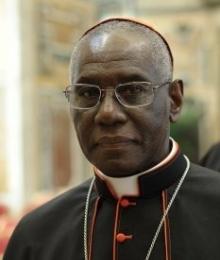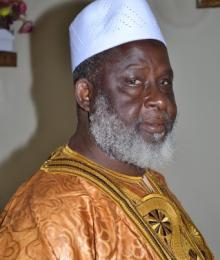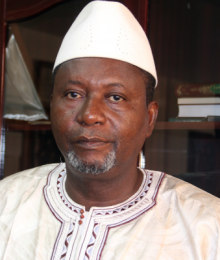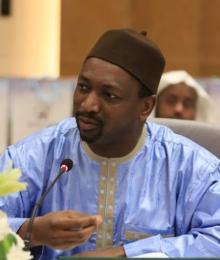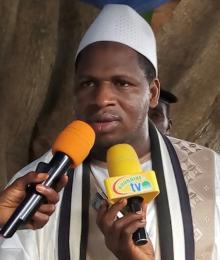


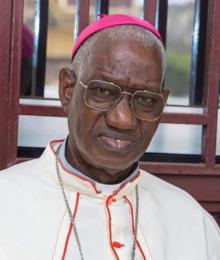
Archbishop Vincent Coulibaly, born on March 16, 1953, in Kéniéran, Guinea, is a Guinean Catholic prelate who left a lasting mark on the Church in West Africa through an episcopate spanning more than thirty years. Ordained a priest in 1981 in the Diocese of Kankan, he was appointed bishop of that same diocese by Pope John Paul II in 1993, before being elevated to Metropolitan Archbishop of Conakry in 2003, succeeding Cardinal Robert Sarah.
President of the Episcopal Conference of Guinea from 2007 to 2013, and a delegate to the Synod on Synodality in 2023 and 2024, he distinguished himself far beyond the boundaries of the Church through his tireless commitment to peace, interreligious dialogue, and national reconciliation. Notably, he co-chaired alongside Imam Mamadou Saliou Camara the National Reflection Commission on Reconciliation, an achievement that earned them both a place among the 100 Africans of the Year 2017.
Elevated to the rank of Grand Officer of the National Order of the Kolatier in 2022, he ultimately submitted his resignation for health reasons on February 28, 2026, which was accepted by Pope Leo XIV. Throughout his tenure, he guided the Guinean Church through decades of political crises, epidemics, and military transitions with a voice that was free, courageous, and deeply rooted in the realities of his people.
Introduction
Vincent Coulibaly is a Guinean Catholic prelate born on March 16, 1953, in Kéniéran, in the prefecture of Mandiana, in French Guinea, five years before the country's independence. A towering figure of the Catholic Church in West Africa, he led the Metropolitan Archdiocese of Conakry for more than twenty years, from 2003 to 2026, before resigning for health reasons on February 28, 2026 — a resignation accepted by Pope Leo XIV, who simultaneously appointed his successor, Archbishop François Sylla.
Family Origins and Historical Context
Vincent Coulibaly was born to Benoît Coulibaly and Élisabeth Doumbouya. He grew up in a minority Catholic community within a predominantly Muslim region of eastern Guinea, against a particularly difficult sociopolitical backdrop. Post-independence Guinea was then governed by Ahmed Sékou Touré, whose Marxist-leaning socialist regime imposed severe restrictions on religious freedom, persecuted the Catholic Church, and obstructed the development of priestly vocations. It was in this environment of silent resistance that the young Vincent forged his faith and discerned his call to the priesthood.
Seminary Formation: From Kindia to Koumi
In November 1969, at the age of sixteen, Vincent Coulibaly entered the Petit Séminaire Jean XXIII in Kindia, Guinea. This initial formation house for priestly candidates provided him with a solid spiritual, intellectual, and human education in the spirit of the Second Vatican Council.
In September 1974, he continued his training at the Grand Séminaire Saint-Pierre-Claver in Koumi, Burkina Faso (then Upper Volta). This advanced formation institution allowed him to deepen his studies in dogmatic theology, moral theology, and canon law, in an environment combining intellectual rigor, community life, and pastoral orientation. The need to pursue his studies abroad was directly linked to the persecutions of the Sékou Touré regime, which made the establishment of a national major seminary in Guinea impossible.
Ordination and Early Ministry
On July 28, 1979, Vincent Coulibaly was ordained a deacon in Kissidougou, in the Diocese of Kankan. Two years later, on May 9, 1981, he received priestly ordination at the Cathedral of Notre-Dame des Victoires et de la Paix in Kankan, at the hands of Robert Sarah, then Archbishop of Conakry and Apostolic Administrator of the Diocese of Kankan.
Following his ordination, he served as a parochial vicar and later as a parish priest in the Diocese of Kankan, carrying out missions of catechesis, parish administration, and community development. He also presided over the Catholic organization for human promotion of the Apostolic Prefecture of Kankan, committing himself from the outset to social development work.
In 1989, he was appointed formator at the Séminaire Jean XXIII in Kindia — the very institution where he had begun his own studies. The following year, in 1990, he became its director, a position he held until December 1993. His leadership of this formation house contributed to the renewal of the Guinean Catholic Church, which was finding its footing again after the death of Sékou Touré in 1984.
Bishop of Kankan (1994–2003)
On November 17, 1993, Pope John Paul II appointed him Bishop of Kankan, making him the second holder of this diocesan see, in succession to Bishop Paul-Pierre Yam Sahibou. He was also the first pastor from within this local Church to accede to the episcopate.
He received episcopal consecration on February 12, 1994, at the Cathedral of Notre-Dame des Victoires et de la Paix in Kankan. Archbishop Robert Sarah served as principal consecrator, with Bishops Mori Julien-Marie Sidibé of Ségou and Philippe Kourouma of N'Zérékoré as co-consecrators.
During his ten years as Bishop of Kankan, Archbishop Coulibaly devoted himself to evangelizing the rural communities of eastern Guinea, to interreligious dialogue with the predominantly Muslim population, and to humanitarian assistance for the displaced persons and refugees created by the rebel attacks of 2000–2001. He established the OCPH, the Guinean branch of Caritas, to coordinate relief efforts. At the 2001 Synod of Bishops, he defended the necessity for the Church to stand alongside the poorest and to give voice to the voiceless.
Archbishop of Conakry (2003–2026)
On May 6, 2003, Pope John Paul II appointed him Metropolitan Archbishop of Conakry, succeeding Robert Sarah, who had been called to Rome to lead the Congregation for Divine Worship and the Discipline of the Sacraments. This appointment established Archbishop Coulibaly as the highest Catholic authority in Guinea.
At the head of the Archdiocese of Conakry, he oversaw major institutions including the Cathedral of Sainte-Marie de Conakry, the seat of the archdiocese. He co-consecrated several bishops: Emmanuel Félémou (Kankan, 2007), Raphaël Balla Guilavogui (N'Zérékoré, 2008), and Alexis Aly Tagbino (Auxiliary Bishop of Kankan, 2017), thereby ensuring the continuity and renewal of the Guinean Catholic hierarchy.
During the Ebola crisis of 2014–2016, the Catholic institutions under his authority mobilized medical resources, organized safe burials, and provided psychosocial support to affected families in partnership with international organizations. His management of this health crisis illustrated his vision of the Church as a force of service at the heart of collective suffering.
President of the Episcopal Conference of Guinea (2007–2013)
From 2007 to 2013, Archbishop Coulibaly served as President of the Episcopal Conference of Guinea, succeeding Bishop Philippe Kourouma and preceding Bishop Emmanuel Félémou. In this capacity, he coordinated the action of Guinea's bishops in the face of the country's pastoral and social challenges. In September 2009, as Guinea was plunged into a deep political crisis following the military coup of December 2008, he issued a declaration calling for dialogue between the authorities and the opposition. This alarm call came just days before the brutal crackdown of September 28, 2009, during which demonstrators were massacred at the Conakry stadium. In November 2009, Archbishop Coulibaly insisted that solutions to the Guinean crisis could only come from within, through inclusive negotiation among all parties.
International Synodal Engagement
As Guinea's representative to the major assemblies of the universal Church, Archbishop Coulibaly participated in October 2009 in the Second Special Assembly for Africa of the Synod of Bishops in Rome. In his intervention during the sixth general congregation, he called for reconciliation, justice, and peace in Guinea, saluted the historic courage of his predecessors — including Archbishops Raymond-Marie Tchidimbo and Robert Sarah — and pleaded for urgent interreligious dialogue among Christians, Muslims, and adherents of African traditional religions. His contributions influenced Pope Benedict XVI's post-synodal apostolic exhortation Africae Munus (2011).
He subsequently participated in the Synod on Synodality (XVI Ordinary General Assembly), attending the first session in October 2023 and the second in October 2024, carrying the voice of the Guinean Church into global debates on ecclesial governance, lay participation, and decentralization.
Defender of Religious Freedom and National Reconciliation
Throughout his episcopate, Archbishop Coulibaly established himself as an independent and courageous voice in Guinean public life. In August 2020, from the Cathedral of Sainte-Marie, he solemnly called on the government and the opposition to end all violence and to establish inclusive dialogue ahead of the presidential election.
In September 2020, he publicly denounced the forced expropriation of land belonging to religious communities in the Kendoumayah neighborhood, calling for the restitution of property and constructive dialogue between the Church and public authorities.
At the National Interreligious Forum in July 2022, he put forward concrete proposals for social cohesion: civic education, the fight against corruption, a reduction in the number of political parties, the establishment of an independent electoral body, and the creation of a truth and reconciliation commission.
On May 30, 2023, speaking before the National Transitional Council, he argued that the new constitution should explicitly guarantee freedom of religion, equal treatment of all faiths, and the participation of religious leaders in a High Council of Religions integrated into a bicameral parliament.
At Easter 2025, during his homily at the Cathedral of Sainte-Marie, he welcomed the CNRD's announcements regarding a constitutional referendum and reparations for the victims of September 28, 2009, while calling for inclusive dialogue to ensure a peaceful return to constitutional order.
Architect of Interreligious Dialogue
From 2011 onward, Archbishop Vincent Coulibaly and Imam Elhadj Mamadou Saliou Camara were appointed co-presidents of the Provisional Reflection Commission on National Reconciliation. Their report, submitted in June 2016, recommended among other things the institutionalization of September 28 as a National Day of Repentance, Forgiveness, and Prayer for Mercy, as well as the systematic use of political dialogue as a means of conflict resolution. This interfaith partnership earned them both recognition among the 100 Africans of the Year 2017.
In April 2022, Archbishop Coulibaly co-chaired the National Consultations launched by the transitional government, delivering a characteristically direct message: "We have talked too much in this country. We must take actions that unite Guineans."
Honors and Distinctions
In 2022, Archbishop Vincent Coulibaly was elevated to the rank of Grand Officer of the National Order of the Kolatier, the highest civilian distinction of the Republic of Guinea.
Final Years and Resignation
In December 2025, shortly before the presidential election of December 28, Archbishop Coulibaly was compelled to vacate his residence at Stella Maris in the Minière neighborhood of Conakry, due to its proximity to the new presidential residence. The Ministry of Urban Planning assigned him temporary accommodation elsewhere in the capital. This episode, experienced as an infringement on the autonomy of the Church, provoked deep emotion within the Catholic community.
On December 27, 2025, he presided over the closing of the 2025 Jubilee Year in Conakry, under the theme Spes non confundit (Hope does not disappoint), issuing a call to civic responsibility and evangelical faithfulness for the twenty-five years ahead.
On February 28, 2026, the Apostolic Nunciature announced that Pope Leo XIV had accepted the resignation of Archbishop Vincent Coulibaly for health reasons. Archbishop François Sylla, until then Coadjutor Archbishop with special faculties, immediately succeeded him, ensuring the pastoral continuity of the Metropolitan Archdiocese of Conakry.
Legacy
Over more than two decades at the helm of the Archdiocese of Conakry, Archbishop Vincent Coulibaly embodied a Church close to the most vulnerable, committed to interreligious dialogue, and resolutely oriented toward social peace. Through political crises, epidemics, military transitions, and land disputes, he maintained a voice that was free, measured, and deeply rooted in Guinean realities. His departure marks the end of an exceptional episcopate, honored by the Catholic community and the whole of Guinean civil society alike.