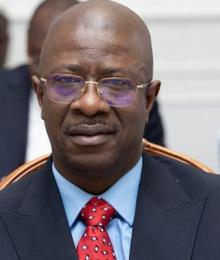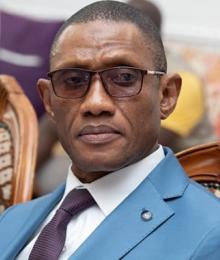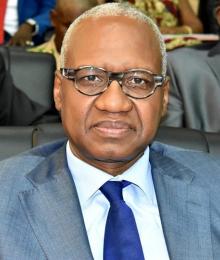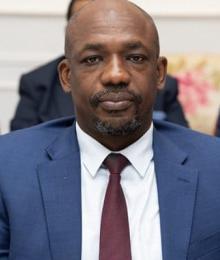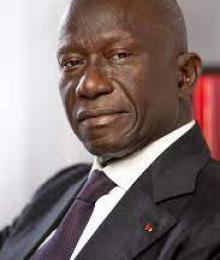



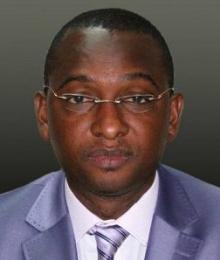
Aboubacar Makissa Camara is a senior Guinean civil servant and former Director General of Taxes of the Republic of Guinea, appointed to the position by President Alpha Condé in January 2016 and dismissed in December 2021 following the coup led by Colonel Mamadi Doumbouya.
Holder of several degrees obtained in France — including two master's degrees from the University of Paris-Dauphine and the University of Paris 13, as well as a Higher Diploma in Accounting from the CNAM in Paris — he established himself over six years as one of the most active reformers in West African tax administration. During his tenure, he consistently delivered strong budgetary results, modernized procedures through digitalization, and in 2021 secured the unanimous adoption of a new General Tax Code by the Guinean Parliament.
Recognized on multiple occasions at the international level, most notably with the African Development Prize in Abidjan in 2019, he has since the advent of the military junta been prosecuted by the Court for the Repression of Economic and Financial Offenses (CRIEF) on alleged charges of embezzlement of public funds, illicit enrichment, corruption, and money laundering. He contests these accusations and is currently abroad for reasons he describes as medical, while his trial, which opened in January 2026, continues before the specialized court in Conakry.
Introduction
Aboubacar Makissa Camara is a central figure in Guinea's tax administration. Born in Fria, in the Boké region of the Republic of Guinea, he led the National Directorate of Taxes (DNI) for nearly six years — from January 2016 to December 2021 — under the presidency of Alpha Condé. A trained Inspector of Financial and Accounting Services, he established himself as one of West Africa's most seasoned tax technicians, combining a dual Franco-Guinean academic background with a concrete practice of administrative reforms. His tenure at the head of this institution was marked by ambitious structural transformations, remarkable financial performances, and repeated international recognition. Since the military coup of September 5, 2021, which ousted President Alpha Condé, his name has been associated with a judicial proceeding for alleged economic and financial crimes, brought before Guinea's Court for the Repression of Economic and Financial Offences (CRIEF). A case that divides public opinion and has yet to reach a definitive conclusion.
From Humble Origins to Academic Excellence
Aboubacar Makissa Camara comes from an ordinary background. He completed his primary education at the Matoto elementary school, continued his secondary schooling at Sangoyah, and then enrolled at the Yimbayah high school in Conakry. After obtaining his baccalaureate, he was admitted to the Faculty of Law and Economic Sciences at Gamal Abdel Nasser University in Conakry, where he graduated top of his class — a first distinction that set the tone for his entire career.
In 1997, he passed a civil service entrance examination and was recruited as a state contractor at the Ministry of Finance. He quickly received additional training at the National School of Financial Administrations (ENAREF) in Ouagadougou, Burkina Faso. Upon his return, he was posted to the National Directorate of Taxes in 2000.
But Aboubacar Makissa Camara was not content with this position. Convinced that the future belonged to those with solid and diverse skills, he decided to continue his studies in Europe. He first enrolled at the University of Saint-Serge in Paris, then at Paris 13 Villetaneuse, where in 2001 he earned a professional degree in public administration from the Faculty of Law, Political and Social Sciences.
In 2002, he obtained a Higher Accounting Diploma (DSC) from the Conservatoire National des Arts et Métiers (CNAM) in Paris. He then went on to earn a professional master's degree in tax administration from the University of Paris-Dauphine, followed by a second master's in European and international tax law from Paris 13. Armed with this dual academic background, he considered pursuing a doctorate, but ultimately chose to return to Guinea to put his skills at his country's service. "One feels more at ease at home than anywhere else," he stated in 2012.
National Director of Taxes
It was by presidential decree on January 14, 2016, that Alpha Condé appointed Aboubacar Makissa Camara to head the National Directorate of Taxes, replacing Ouo Oua Waita Monémou. This choice was part of the policy of rejuvenating and feminizing Guinea's civil service championed by the head of state.
From the moment he took office, Aboubacar Makissa Camara made his ambitions clear: to prioritize competence, rejuvenate teams, and pursue excellence in tax revenue mobilization. He quickly moved from words to action. Within a few weeks, he carried out a sweeping internal reorganization, appointing young executives and women to positions of responsibility within the DNI's sections and divisions, in line with criteria of equity, competence, and experience.
On the financial front, the results spoke for themselves. When he took office, tax revenues were stuck at around 4,000 billion Guinean francs. In 2017, they exceeded 5,000 billion. Projections for 2018 climbed to approximately 7,500 billion. By the end of March 2017, against a target of 1,032.22 billion, the DNI recorded a collection of 1,036.84 billion, representing an execution rate of 100.45%. Key categories such as corporate taxes (120.47%), withholding income taxes (124.88%), and fiscal stamps (141.21%) showed notable surpluses.
Among the most significant structural reforms were the securing of revenues from vehicle stamp duties, the creation of the Tax Identification Number for Natural Persons (NIF-P), and the establishment of Certified Management Centres (CGA), designed to broaden the tax base. Aboubacar Makissa Camara also fostered a strategic rapprochement between the DNI and the country's banking institutions — a collaboration authorized by the Guinean Parliament with the aim of improving the monitoring and traceability of financial flows from economic operators.
He also focused on the technological modernization of his administration, accelerating the digitalization of tax procedures through the eTax and SAFiG solutions. These tools enabled taxpayers to file and pay their taxes remotely, reducing processing times, strengthening payment security, and improving communication between the administration and taxpayers. He would himself assess the impact of these transformations in a rigorous academic work published under the title The Digitalization and Big Data: What Impact on the Performance of the Tax Administration in the Republic of Guinea — an intellectual contribution that reflects his enduring commitment to research and theoretical reflection.
From a managerial perspective, he also developed a culture of proactive tax auditing, multiplying meetings with senior staff across various departments — notably the Medium Enterprise Service (SME) — to drive even greater revenue mobilization and to reinforce the principle that administrative effectiveness depends above all on the active engagement of every field agent.
One of the institutional highlights of his mandate was the adoption, in May 2021, of the new General Tax Code by the Guinean National Assembly, passed unanimously. This text, the fruit of extensive consultations with all relevant stakeholders, modernized the country's legal tax framework in depth and removed the most glaring shortcomings of the previous tax legislation.
African and International Recognition
The achievements realized under Aboubacar Makissa Camara's leadership did not go unnoticed across the continent. In October 2017, he represented Guinea at an economic forum in Casablanca, Morocco, where he highlighted the tax reforms undertaken in his country and their attractiveness for foreign investors. He particularly emphasized the tax simplifications carried out and the strengthened collaboration between the DNI and banking institutions.
In March 2019, in Abidjan, at the 5th edition of the African Development Prize (PAD) organized by the Ivorian agency Ivoire Prestige Services Communication, he received the award for best agent for professionalism and the development of taxation in the fiscal category. During this same period, the PADEV Foundation and the 225 Foundation also distinguished him as the best manager of financial administrations in Africa.
Beyond the fiscal sphere, he engaged in the education of Guinean youth through his movement Wo Alou Akha Kha Wali Ra Gnon, which launched a digital scholarship program to prepare young graduates for careers in information and communication technologies. In Fria, his hometown, the 38th graduating class of the Technical and Vocational Training Centre was named in his honour during a solemn ceremony held in November 2019.
The Fall: Dismissal, Accusations and Exile
On September 5, 2021, Colonel Mamadi Doumbouya overthrew President Alpha Condé in a military coup. In December of the same year, Aboubacar Makissa Camara was dismissed by decree of the National Committee of Rally and Development (CNRD), and replaced at the helm of the DNI by Mory Camara, who had until then served as director of the Medium Enterprise Service.
The months that followed saw a succession of judicial proceedings. The CRIEF, a court specializing in the repression of economic and financial crimes, indicted him on charges of embezzlement of public funds, illicit enrichment, corruption, and money laundering. In July 2022, an international arrest warrant was issued against him, and his assets — including villas in Dubréka and in the prefecture of Fria — were seized.
Having been abroad since the coup, Aboubacar Makissa Camara did not appear at the hearings. His lawyers, Me Salifou Béavogui and later Me Soufiane Kouyaté, justified his absence on medical grounds and academic commitments. The defence contested the characterization of their client as a "fugitive" and asserted that he had nothing to reproach himself for.
The trial officially opened on January 12, 2026, before the trial chamber of the CRIEF. At the hearing, the court ordered the verification of all the defendant's bank accounts and those of his family at the country's primary banks, as well as the identification of his real estate holdings in Conakry, Kindia, and other parts of the country through the National Directorate of Domains and Cadastre. The case was adjourned to March 4, 2026, pending the full execution of these precautionary measures.
Looking Ahead, From Exile
From France, where he says he resides for health and educational reasons, Aboubacar Makissa Camara has not entirely withdrawn from public life. On the occasion of International Women's Rights Day in March 2024, he addressed a message to the women of Guinea, calling for peace, tolerance, and national cohesion. In August 2024, on the anniversary of Guinea's independence, he published a spiritual and civic meditation, inviting his compatriots to work toward a more just and more united nation.
These public statements paint the portrait of a man who, despite the ongoing judicial proceedings, intends to remain a voice in Guinean public debate, championing values of dialogue and reconciliation.
Conclusion
Aboubacar Makissa Camara remains a complex and controversial figure in contemporary Guinea. Recognized across Africa as a reformer for his management of the tax administration, he is also at the centre of a judicial proceeding emblematic of the campaign waged by the Guinean junta against alleged economic crimes of the Condé era. His fate illustrates, in many respects, the deep tensions that run through African states in transition: between the legitimate desire to clean up public management and the risk of justice being instrumentalized for political ends. The judicial truth about his case belongs only to the courts, and the presumption of innocence remains, in any event, an indispensable cornerstone.
His journey — from the school in Matoto to the universities of Paris, then to the heights of Guinea's tax administration — remains, whatever the judicial outcome, an example of a meritocratic trajectory in a country still in search of its enduring institutions. History will record that for six years, he contributed to profoundly transforming the way Guinea perceives, collects, and administers its tax revenues.