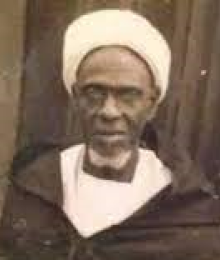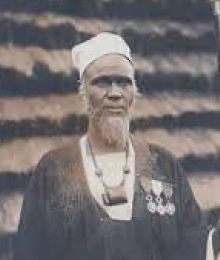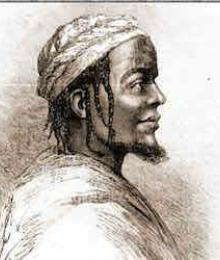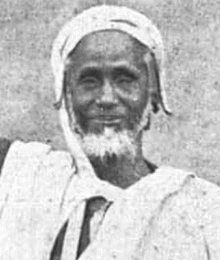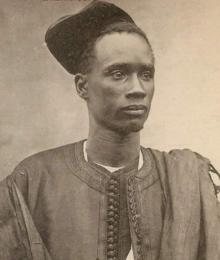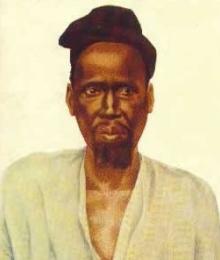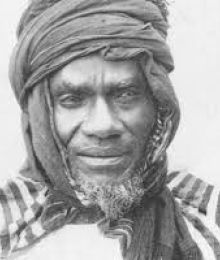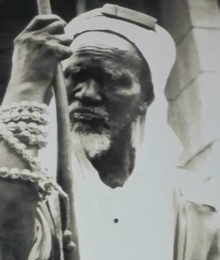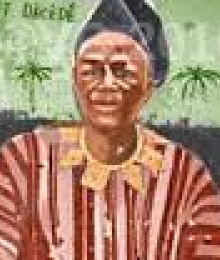




Morifindjan Diabaté was the official griot and personal advisor to Samory Touré, founder of the Wassoulou Empire in the nineteenth century. Descended from the prestigious Diabaté lineage, one of the most respected griot families in the Mandingue cultural area, he became Samory's jeli fasa (personal griot) in the 1860s and played a role far broader than that of a simple singer: he was simultaneously a court historian, strategic advisor, diplomat, and the sovereign's official spokesperson.
Accompanying Samory on his military campaigns and diplomatic missions, Morifindjan used his mastery of speech and his encyclopedic knowledge of Mandingue traditions to mobilize troops, facilitate alliances, and strengthen the chief's authority. His most lasting contribution lies in his function as guardian of collective memory: through his epic narratives and songs, he structured and transmitted the history of the Wassoulou Empire and the resistance against French colonization, transforming Samory Touré into a pan-African symbol of anticolonial struggle. Even after his master's capture in 1898, Morifindjan continued to spread this heroic memory, thus ensuring the transmission of an oral heritage that still inspires the griots of Guinea, Mali, and Côte d'Ivoire today.
Introduction
In the precolonial history of West Africa, certain figures remain etched in collective memory not by the sword, but by the word. Morifindjan Diabaté perfectly embodies this tradition where speech possesses a power as decisive as military force. The official griot of Samory Touré, founder of the Wassoulou Empire, Morifindjan was far more than a simple storyteller: historian, political advisor, diplomat, and guardian of collective memory, he played a fundamental role in the construction and transmission of one of the greatest epics of anticolonial resistance in nineteenth-century Africa.
Origins and Family Heritage
Morifindjan Diabaté came from the prestigious lineage of the Diabaté, one of the oldest and most respected griot families in the Mandingue cultural area. In this vast cultural region extending from Guinea to Mali through Côte d'Ivoire, the name Diabaté immediately evokes excellence in the griotic art. This family distinguished itself for centuries as the privileged repository of sacred speech, royal genealogies, and epic narratives that constitute the intangible heritage of the Mandingue peoples.
Born in an environment where oral tradition occupies a central place in social and political organization, Morifindjan grew up surrounded by masters of speech. From a very young age, he was initiated into the subtleties of jeliya, a term designating the professional art of the griot in Mandingue society. This apprenticeship was not limited to simple memorization of stories: it encompassed complete training in complex genealogies, major historical events, the social and moral norms of the Mandé, as well as mastery of traditional musical instruments.
Rigorous Training
The education of a high-ranking griot like Morifindjan follows a long and demanding process, based on intergenerational oral transmission. For many years, the young apprentice must memorize thousands of verses, learn the linguistic subtleties of classical Mandingue, and understand the historical allusions that enrich each narrative. This training also includes learning emblematic instruments such as the kora (a twenty-one-stringed harp-lute), the ngoni (traditional lute), and the balafon (African xylophone), which accompany and magnify epic recitations.
Beyond the artistic dimension, this education prepares griots to assume considerable political and social responsibilities. They must master the art of diplomatic discourse, know how to flatter without servility, criticize without offending, and remind the powerful of their duties toward the community. It was in this context that Morifindjan was trained, at a time when traditional political structures were undergoing profound changes under the combined effect of regional wars, trans-African trade, and growing colonial pressure.
The Decisive Meeting with Samory Touré
Although the precise date remains uncertain—as is often the case in oral history where events are dated by reference to other significant facts—accounts converge to place the meeting between Morifindjan and Samory Touré in the 1860s. During this period, Samory emerged as a major military leader in Wassoulou, a region located in present-day Guinea. A merchant turned warrior, he worked to unite various communities and build a modern military organization capable of resisting external threats.
Recognizing Morifindjan's exceptional talents, Samory quickly elevated him to the rank of jeli fasa, a title designating the sovereign's personal griot. This appointment was not a simple ceremonial honor: it conferred extensive responsibilities on Morifindjan that went far beyond the artistic domain. As jeli fasa, he became the chief's official spokesperson, the one who sang of his exploits to mobilize troops before battles, the one who advised in the shadows during strategic decisions, and the one who sometimes represented the sovereign in delicate negotiations.
A Leading Political Actor
Reducing Morifindjan to a simple singer would constitute a serious misunderstanding of the nature of the griotic role in traditional Mandingue societies. The griot of a great chief is above all a political advisor, a court historian, a diplomatic spokesperson, and a social mediator. Morifindjan accompanied Samory in his travels across the empire, participated in military campaigns, and attended negotiations with neighboring chiefs or foreign emissaries.
In critical moments, his voice intervened to recall ancient alliances, invoke historical precedents, prevent internal conflicts, or strengthen army cohesion. His encyclopedic knowledge of genealogies allowed him to establish symbolic kinship ties between distant groups, thus facilitating alliances. His mastery of discourse and his ability to mobilize common cultural references made him a formidable negotiator, capable of convincing through speech where weapons would have failed.
Several testimonies from oral tradition suggest that Morifindjan participated directly in diplomatic missions to neighboring kingdoms and perhaps even during the first contacts between the Wassoulou Empire and French representatives. In a context where diplomacy relies largely on rhetoric, protocol, and shared cultural references, the griot's role proves absolutely central.
Guardian of Collective Memory
While Morifindjan's immediate political impact was considerable, his most lasting contribution lies in his function as memorialist of the Wassoulou Empire. Through his songs, narratives, and epics, he organized, structured, and transmitted the collective memory of a decisive era. His compositions meticulously described the battles against the Kaba of Kankan, territorial conquests toward the south, innovative military reforms, strategic alliances, the betrayals that shook the empire, and especially the heroic confrontations against French colonial troops.
In a society based on orality, the griot truly represents a "living library." Morifindjan recorded in his prodigious memory the major events of Samory Touré's reign: the victories that extended the empire, the defeats that weakened it, innovative military strategies, and the sovereign's political vision. This memory was not limited to a simple chronology: it included the motivations, contexts, diplomatic stakes, and symbolic dimensions of each event.
It is thanks to the narratives of Morifindjan and his descendants that several generations of Mandingue people have preserved a precise and vivid memory of the Samorian epic, despite the destruction of the empire in 1898 and the massive upheavals imposed by French colonization.
The Trial of Defeat
The year 1898 marks a tragic turning point: Samory Touré was captured by French troops at Guélémou, in present-day Côte d'Ivoire, after more than fifteen years of fierce resistance. While colonial written sources do not explicitly mention Morifindjan's fate at this precise moment, oral tradition reports that he continued his mission after his master's capture. Refusing oblivion and moral defeat, he continued to spread the history of resistance among the dispersed populations.
Some accounts suggest that he accompanied groups of demobilized soldiers, keeping the flame of collective memory alive and progressively transforming the painful events of military defeat into a heroic narrative destined to inspire future generations. In periods of crisis and political collapse, griots assume an essential function: reconstructing collective meaning, preserving cultural identity, and offering the community a narrative that allows them to overcome trauma.
Morifindjan excelled in this difficult role, contributing decisively to transforming the image of Samory Touré. Once perceived ambivalently in certain regions due to his sometimes brutal conquests, Samory progressively became, thanks notably to his griot's memorial work, a pan-African symbol of anticolonial resistance, respected far beyond the borders of his former empire.
Heritage and Legacy
The influence of Morifindjan Diabaté transcends his era by far. In the twentieth century, his narratives were collected by numerous researchers, historians, and anthropologists interested in Mandingue history and the epic of the Wassoulou Empire. These academic works revealed the remarkable narrative precision, linguistic richness, and historical depth of the traditions transmitted by his lineage.
Even today, Morifindjan's name resonates in the griot circles of Guinea, Mali, and Côte d'Ivoire. The Diabaté of the Upper Niger proudly claim their spiritual filiation with this legendary master. He remains an emblematic example of the multidimensional role of the griot in traditional African societies: not only an accomplished artist and musician, but also an intellectual, historian, diplomat, and leading political actor.
Conclusion
Morifindjan Diabaté embodies the very essence of the West African griotic tradition in all its complexity and richness. Far from the reductive cliché of a simple singer or entertainer, he was a major actor in the political and cultural history of nineteenth-century Mandingue society. His journey brilliantly illustrates how, in societies of oral tradition, speech constitutes a power comparable to military force or economic wealth. Guardian of memory, political advisor, skillful diplomat, and inspired artist, Morifindjan remains an essential figure for anyone interested in the precolonial history of West Africa and the fundamental role of griots in the construction and transmission of African cultural heritage.